| Chemical Composition and Energy Values of the foods per 100g of edible part | ||
| Edible part | % | 80 |
| Water | g. | 88,3 |
| Proteins | g. | 2,3 |
| Lipids | g. | 0,2 |
| Carbohydrates | g. | 2,4 |
| Starch | g. | 0,2 |
CULTIVATION PERIOD:


CULTIVATION TECHNIQUES:
Integrated crop production in open field.
DESCRIPTION:
Due to its properties, it is considered a super-food.
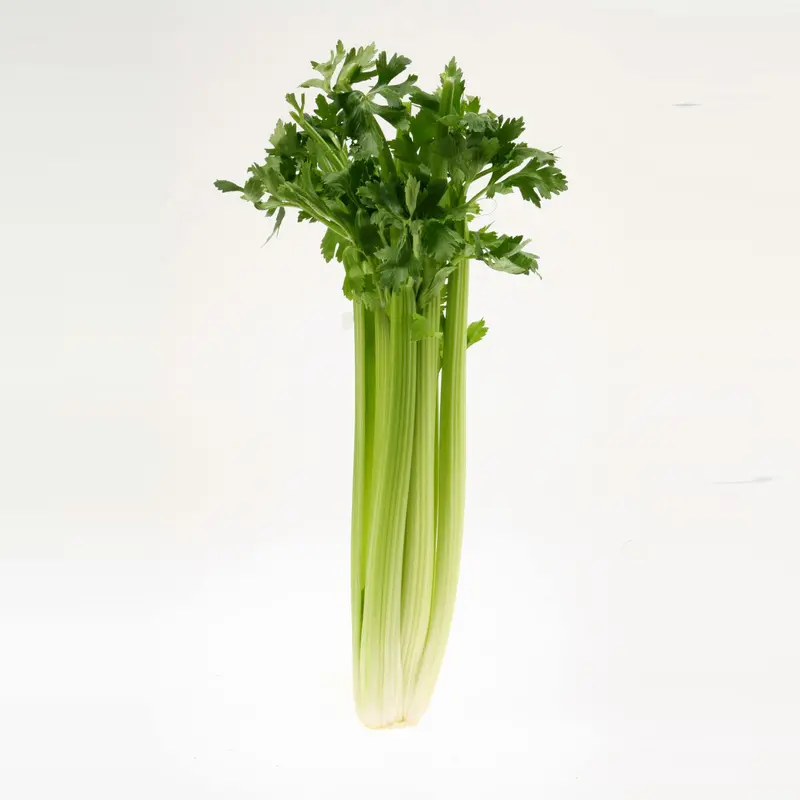
It has a long, cylindrical head consisting in full, intense green stalks that become lighter towards the exterior and a crunchy, white heart. Its weight varies between 700 and 900 grams.
HEALTH ADVANTAGES:
Celery is rich in fibre, A, B, C and E group vitamins, beta-carotene, folic acid, potassium and sodium. It also contains phytohormones and cumarin (which are useful in the prevention of cancer and stimulate the activity of some leukocytes).
·It is useful for treating cardio-circulatory illnesses and disorders of the liver and kidneys, gout, atonic constipation (due to its fibre content), tiredness and stress.
·It is aperitif, digestive, stimulating (due to the presence of an aromatic substance) and diuretic (only if eaten fresh and raw).
·The juice, obtained using an extractor, is ideal for intensive anti-rheumatic treatments.
Due to its low calorie content is it particularly suited for use in diets.
USES IN THE KITCHEN:
Celery is usually eaten raw, in mixed salads or served with a dip. Alternatively, it can be baked au gratin in the oven. It is also used to flavour soups and meat dishes, often combined with onion and carrots.
CULTIVATION TECHNIQUES:
Integrated crop production in open field.
DESCRIPTION:
Due to its properties, it is considered a super-food.
It has a long, cylindrical head consisting in full, intense green stalks that become lighter towards the exterior and a crunchy, white heart. Its weight varies between 700 and 900 grams.
HEALTH ADVANTAGES:
Celery is rich in fibre, A, B, C and E group vitamins, beta-carotene, folic acid, potassium and sodium. It also contains phytohormones and cumarin (which are useful in the prevention of cancer and stimulate the activity of some leukocytes).
·It is useful for treating cardio-circulatory illnesses and disorders of the liver and kidneys, gout, atonic constipation (due to its fibre content), tiredness and stress.
·It is aperitif, digestive, stimulating (due to the presence of an aromatic substance) and diuretic (only if eaten fresh and raw).
·The juice, obtained using an extractor, is ideal for intensive anti-rheumatic treatments.
Due to its low calorie content is it particularly suited for use in diets.
USES IN THE KITCHEN:
Celery is usually eaten raw, in mixed salads or served with a dip. Alternatively, it can be baked au gratin in the oven. It is also used to flavour soups and meat dishes, often combined with onion and carrots.